
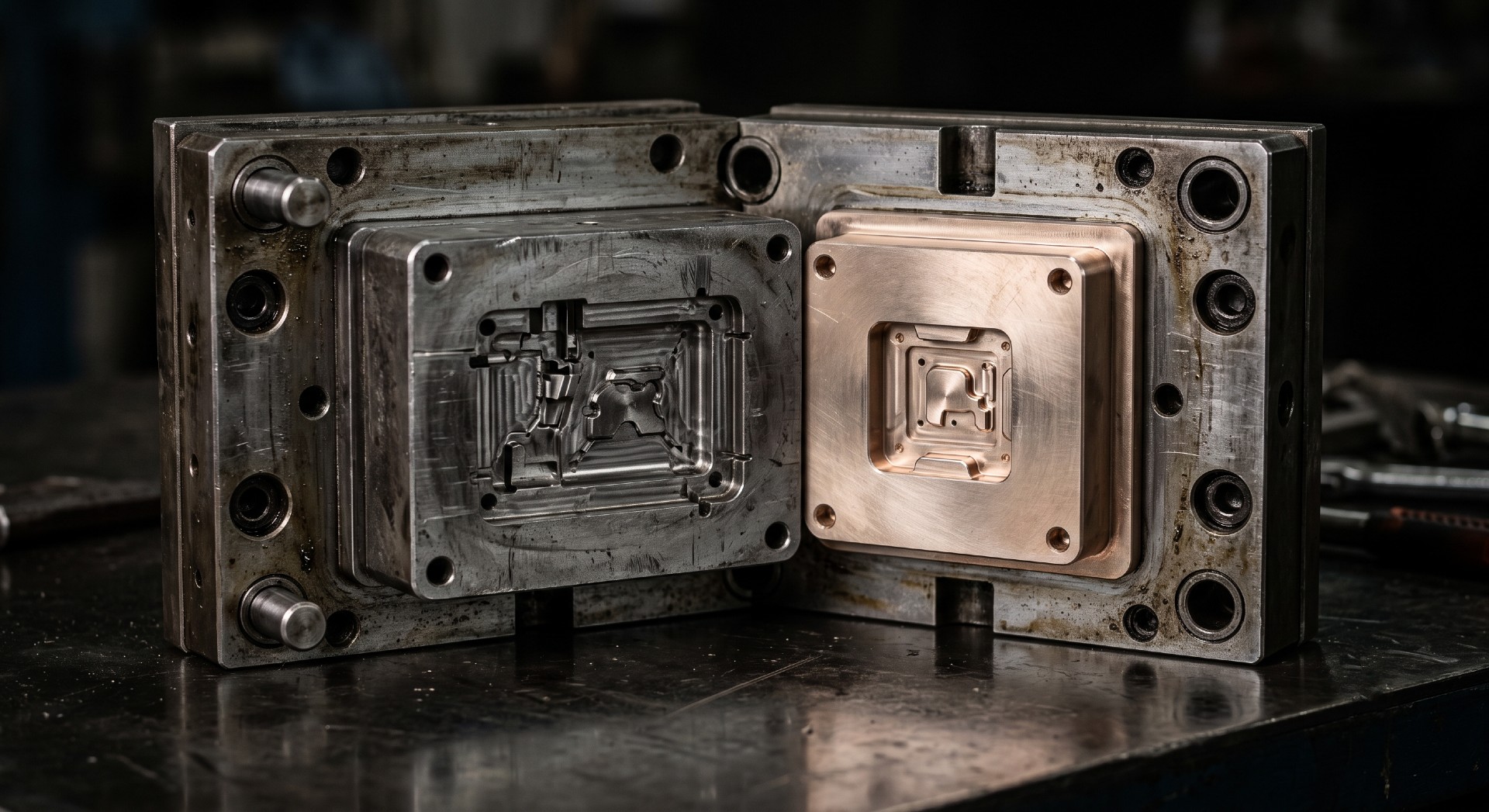
A tooling quote looks like one number. It is actually six separate decisions bundled together, and most engineers approve the total without knowing which decision moved the price. That is how two quotes for the identical part can land twenty or thirty percent apart with neither supplier doing anything wrong, and how a fast, cheap quote can turn out to be fast because nobody actually walked the geometry before pricing it.
1. Steel or aluminum
P20 ships pre-hardened, machines fast, and is the standard choice under roughly 300,000 to 500,000 shots. H13 hardens to 48 to 52 HRC after heat treatment and handles abrasive glass-filled resin and runs past half a million shots.
Aluminum tooling costs a fraction of steel—sometimes a small fraction, sometimes a large one, depending on part size—builds in roughly half the lead time, and delivers 10,000 to 100,000 shots depending on alloy and geometry. For a first production run, aluminum or soft P20 is very often the correct starting point. You are not committing forever. You are buying validated parts fast and cutting hardened steel once the design has earned it.
2. Dedicated tool or shared frame
This is the variable most quotes skip past entirely. A dedicated mold base is built once for that one part and nothing else. A MUD frame (short for Master Unit Die) is a reusable steel base that stays in the press while only the cavity and core insert get swapped for each new part.
The insert alone typically costs 40 to 60 percent less than a full dedicated mold, because the insert skips the ejector plate, the structural plates, and the machining that a full base requires. The tradeoff is real limits: most MUD frames top out around 150 × 200mm and one to four cavities. Above that footprint, or once real volume justifies a dedicated multi-cavity tool, the shared frame stops being the cheaper option.
3. Cavitation strategy
Single cavity costs the least, is the easiest to modify, and carries zero fill-balance risk because there is only one cavity.
Multi-cavity lowers cost per part once volume justifies it, but every cavity must match the others closely, and correcting one risks throwing off the rest.
Family molds—different parts sharing one base—cost less than building separate tools when the parts ship as a matched set, but the cavities are rarely identical in flow length, so one short-filled cavity can scrap the whole shot as a usable pair.
4. Actuation
A straight-pull tool with no side features is priced very differently from one with sliders. A hand-loaded slide, where an operator manually inserts a piece before the shot, is cheap in tooling and expensive in labor per part. A mechanical cam-pin slide adds a defined, bounded cost to the base tool. A hydraulic core pull adds the most, both in tooling and in ongoing maintenance.
Actuation type is often the single biggest line item hiding inside a number that looks like it is only about steel.
5. Cooling design
Cooling represents 60 to 80 percent of total cycle time, which makes it one of the largest hidden levers in per-part cost. Straight-drilled channels are the standard and the cheapest to machine.
Conformal cooling—channels that follow the part's contour rather than running in straight lines—can cut cooling time by 30 to 40 percent or more, but requires additive-manufactured inserts and a meaningfully higher tooling cost. For most low- to mid-volume parts, straight-drilled cooling is the right call. Conformal earns its cost at higher volumes or on geometry complex enough that straight channels leave real hot spots.
6. Tolerance and finish class
A tight-tolerance cosmetic A-side surface demands more metrology, more polishing labor, and more rework allowance than a hidden structural part cut from the identical steel. This is pure machining and inspection time, independent of material or cavitation, and it is the variable most likely to be under-quoted by a supplier who priced the part from a quick glance at the model rather than a real tolerance stack-up.
💡 The six questions to ask before you approve any quote
- Shot Count: What shot count is this steel and cavity configuration actually built for, and does that match my real order volume for the next 12 to 18 months?
- Tool Base: Does my part fit a MUD frame, and if so, why am I being quoted a dedicated base?
- Cavitation: Is the cavitation single, multi, or family, and if family, how was flow balance verified?
- Actuation: What actuation does this design require, and is that priced as its own line item or buried in the total?
- Cooling: Is the cooling straight-drilled or conformal, and does that match what my volume actually justifies?
- Tolerance Stack: Was the tolerance stack-up walked before this number was quoted, or is this a rough-order estimate?
If a supplier cannot answer these six without going back to re-check the part, the quote was priced fast, not properly. That gap surfaces at the T1 sample, not before.