
Every plastic part comes out of the mold smaller than the steel that shaped it. Molten resin fills a cavity, then cools and contracts as it solidifies, and the toolmaker has to cut that cavity larger than your finished part by exactly the amount the material will pull back.
That number gets locked into steel before your prototype is even finished, and it is specific to one material. Change the material later, and you haven't made a simple substitution; you've potentially invalidated the tool.
The real dividing line isn't the material's name
It's whether the material is amorphous or semi-crystalline.
Amorphous resins cool into a random molecular arrangement and shrink slowly and predictably. Semi-crystalline resins partially reorganize into dense, ordered crystalline structures as they cool, which pulls in significantly more material and does so unevenly—shrinking more in the direction the plastic flowed than across it (anisotropic shrinkage).
That single distinction explains almost everything else in this chapter. ABS and PC can sometimes share a tool because they're both amorphous and sit in almost the same shrink range. Nylon and polypropylene almost never can—not because they're chemically incompatible, but because they're semi-crystalline and shrink two to five times more, unevenly, in a direction ABS and PC barely notice.
Glass fiber changes which group a material belongs to
Adding glass fiber to a semi-crystalline resin doesn't just add stiffness; it suppresses and stabilizes shrinkage, often pulling a high-shrink material down close to amorphous territory. Unfilled nylon 6 shrinking at 0.7% to 1.5% can drop to roughly 0.2% to 0.5% at 30% glass loading.
This is why a glass-filled nylon part behaves far more predictably in tooling than the unfilled version, and why swapping fiber content later—not just the base resin—still requires re-checking your shrink assumption.
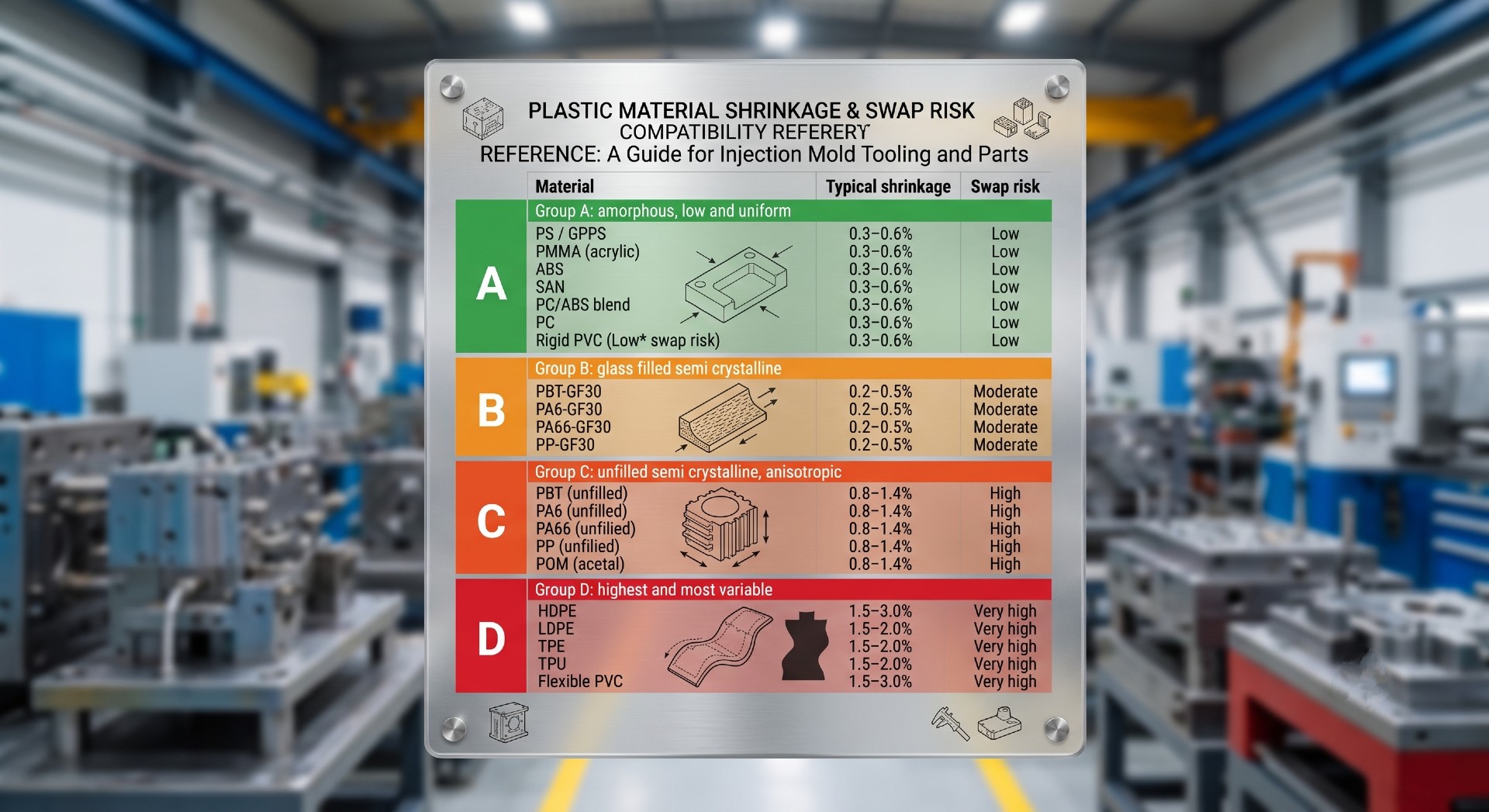
The reference table
Datasheet values below are typical ranges, measured on small flat test plaques under controlled conditions, not on your actual part. Treat the compatibility grouping as a starting point for a conversation with your toolmaker, not a guarantee.
| Group / Material | Typical Shrinkage | Swap Risk |
|---|---|---|
| Group A: Amorphous (Low & Uniform) | ||
| PS / GPPS, PMMA (Acrylic), ABS, SAN, PC/ABS, PC | 0.3 – 0.6% | Low |
| Rigid PVC | 0.3 – 0.6% | Low* |
| Group B: Glass Filled Semi-Crystalline | ||
| PBT-GF30, PA6-GF30, PA66-GF30, PP-GF30 | 0.2 – 0.5% | Moderate |
| Group C: Unfilled Semi-Crystalline (Anisotropic) | ||
| PBT (unfilled), PA6 (unfilled), PA66 (unfilled), PP (unfilled), POM (acetal) | 0.8 – 1.4% | High |
| Group D: Highest & Most Variable | ||
| HDPE, LDPE, TPE, TPU, Flexible PVC | 1.5 – 3.0% | Very High |
Reading the table practically: a tool cut for anything in Group A can plausibly accommodate other Group A materials with minor dimensional drift on non-critical features. Crossing from Group A into Group B, C, or D is a different tool, full stop, regardless of how similar the materials might otherwise seem.
Why does getting the direction wrong matter more than getting the number wrong?
If the real material shrinks less than the tool assumed, the part comes out oversized, and that's usually fixable; steel can be removed from a cavity in routine machining ("steel-safe").
If the real material shrinks more than assumed, the part comes out undersized, and there's no clean way to add cavity space back in. You're welding and remachining—slower, more expensive, and far less precise than the original cut ever was.
The datasheet number is a starting point, not a promise
Published shrinkage values are measured on small flat test plaques, typically 60mm × 60mm × 2mm, under controlled lab conditions. Real part shrinkage can deviate 15% to 40% from that published number depending on your actual wall thickness, gate location, and cooling balance.
A toolmaker who has run that specific material before, on parts with real geometry, is working from better data than the datasheet alone provides, which is exactly why this decision is genuinely shared rather than something either party owns outright.
One more wrinkle worth knowing for nylon specifically: post-mold shrinkage. Nylon keeps shrinking for hours to days after ejection as internal moisture and stress relax, adding another 0.2% to 0.5% beyond what you measured coming off the press. A part that looks in tolerance the day it's molded can drift out of spec by the time it's actually inspected.
💡 The one thing to lock down before the tool is cut
Commit to your material family—amorphous or semi-crystalline—and your fiber loading before tooling starts. If you're not fully certain yet, choose a material from the same compatibility group as your most likely production material, not just whatever's convenient for the prototype. Switching within a group is a minor recalibration. Switching across groups is a different tool, a different budget, and a different timeline.