
Everyone compares the wrong number. A tool costs three times as much in Europe as Offshore, so the decision seems made before it starts. But unit price is the sticker on the window, not the cost of the car.
The real number is landed cost per usable part, and it is built from several independent factors that can point in completely different directions for the same product. This chapter is not about which geography wins; it is about the factors that actually decide, and why the honest answer is often "it depends on the part."
Factor one: how many iteration loops you will actually pay for
The common wisdom says offshore tooling means slow iteration. That is only half true, and the true half is your fault, not the geography's.
An offshore toolmaker can cut a production tool in 20 to 50 days, often faster than a European shop builds the same tool. What is genuinely slower offshore is each revision loop once the tool exists, because every T0 to T1 cycle carries the shipping lag covered in Chapter 12.
Here is the lever most teams miss: the distance penalty is per loop, and the number of loops is set by your DFM discipline, not your supplier's postcode.
A part that arrives at tooling properly designed—with draft everywhere, uniform walls, resolved undercuts, and locked material—closes DFM in one round and needs one or two sample loops. A part that was never reviewed needs three or four.
💡 The DFM distance rule
"Offshore is slow to iterate" is really "I didn't do my DFM homework." Fix the design before it ships and the distance stops mattering, because you are not making the round trip four times.
Factor two: the empty volume you are paying to ship
This is the factor almost nobody costs in, and it can flip the entire decision on its own.
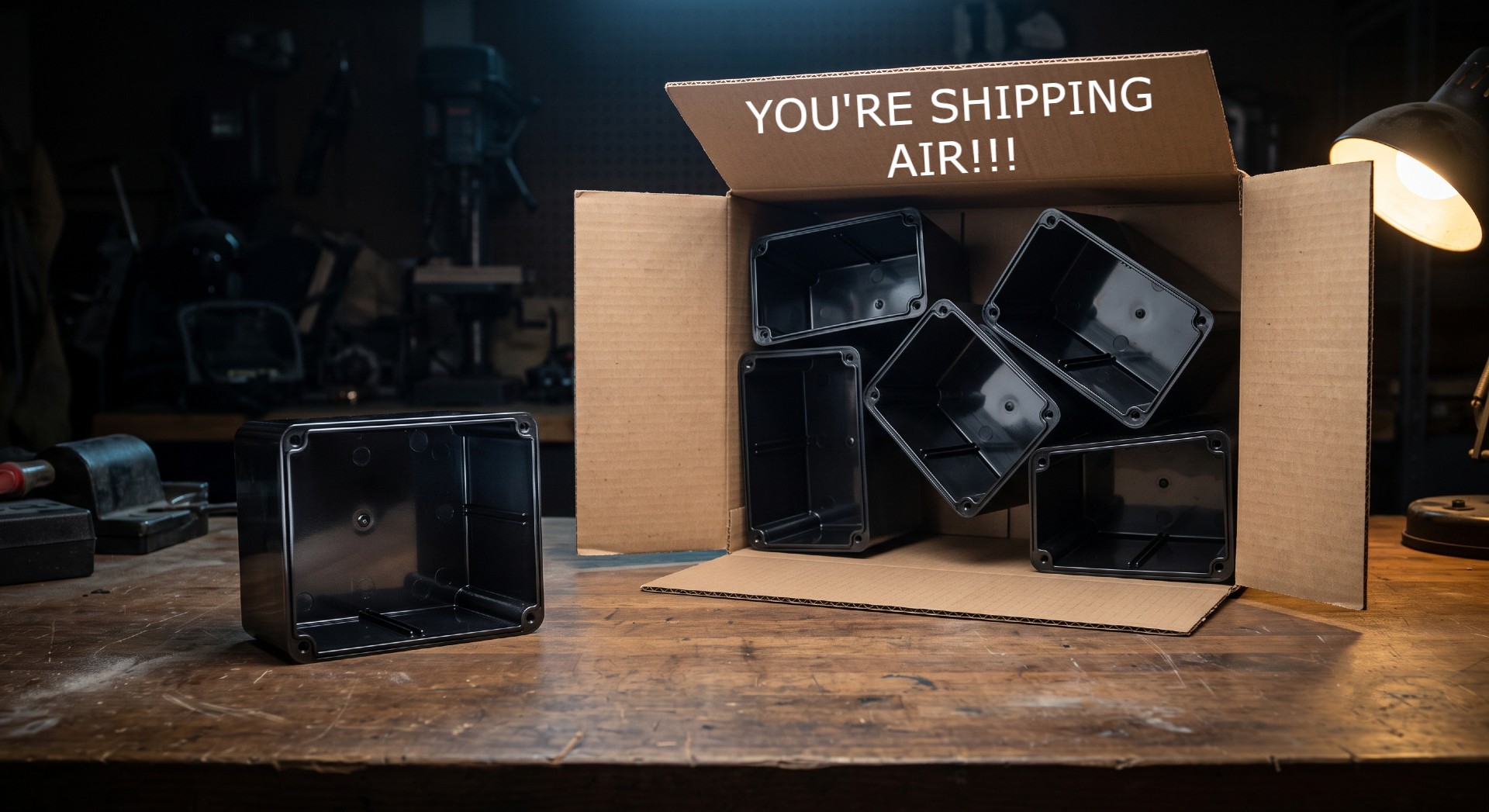
Freight prices on volume (CBM), not just weight. A dense, heavy part ships cheaply relative to its value. A hollow part ships expensively, because you are paying to move empty air across an ocean. And critically, whether parts nest or stack changes everything.
Consider two products with the same unit price offshore: One is a solid, dense component that packs tightly by the thousand. The other is a large hollow enclosure that cannot nest, so each box is mostly air. The dense part can be made anywhere and shipped anywhere because freight is a rounding error on its landed cost. The bulky enclosure is a different problem entirely: shipping it across the world can cost more than the tooling saving that sent it there in the first place.
⚠️ Does your part nest?
Before you compare unit prices, ask whether your part stacks. A part that nests tightly forgives distance. A hollow, non-stackable part punishes it, because you are chartering container space for empty volume on every single unit, forever.
Factor three: volume, and why it points the opposite way for bulky parts
Volume interacts with that freight problem in a way that inverts the usual advice:
- For a small run of a bulky, non-stackable part: Making everything offshore often still wins. You pay the freight on empty volume, but you only pay it on a few units, and the tooling saving dominates. Distance is cheap when you are shipping fifty boxes.
- For large, stable production of that same bulky part: The logic flips. Now you would be shipping empty volume on tens of thousands of units, indefinitely, and that recurring freight dwarfs any tooling saving.
This is exactly where the hybrid middle path earns its place: cut the tool offshore, iterate it offshore until the design is validated, then ship that one validated tool to Europe and run the ongoing production locally. You pay freight on a single crate once, instead of on a permanent river of air.
Factor four: geometry sensitivity, the quiet tiebreaker
The last factor is how much the part's success depends on tight tooling oversight. Loose-tolerance parts survive a long-distance, low-touch process fine.
Parts with tight mating features, cosmetic Class-A surfaces, or sensitive IP benefit from proximity, because standing over the bench during tuning is worth more than any spreadsheet saving. This factor rarely decides alone, but it breaks ties when the cost factors land close.
The factors assembled: where the three structures actually come from
The three sourcing structures are not a menu you pick from. They are what you get when you combine these core factors:
| Your Situation | The Structure It Points To |
|---|---|
| Dense stackable part, high volume, frozen design | Tool and parts both offshore. Freight is cheap; unit cost dominates. |
| Bulky non-stackable part, low volume | Often still all offshore. Freight hurts, but only on a few units. |
| Bulky non-stackable part, large stable volume | Tool offshore, ship the tool once, produce in Europe to eliminate recurring freight. |
| Still iterating, weak DFM, tight tolerances or sensitive IP | Everything local. Pay the tooling premium to buy speed and direct control. |
| Well-designed part, disciplined DFM, any volume | Offshore tooling becomes viable regardless, because you pay the distance penalty once. |
The one number to compute before you decide
Stop comparing tooling quotes and unit prices side by side. Compute landed cost per usable part instead:
Landed Cost = Unit Price + Freight (on actual CBM) + Amortized Iteration Loops + (Tooling Cost / Total Volume)
Run that number for a dense part and offshore usually wins clean. Run it for a bulky enclosure at volume, and the answer can invert completely, pointing you to cut the tool offshore and mold locally. The sticker price told you none of that. The landed cost tells you everything, and it is the only number that has ever actually mattered.