
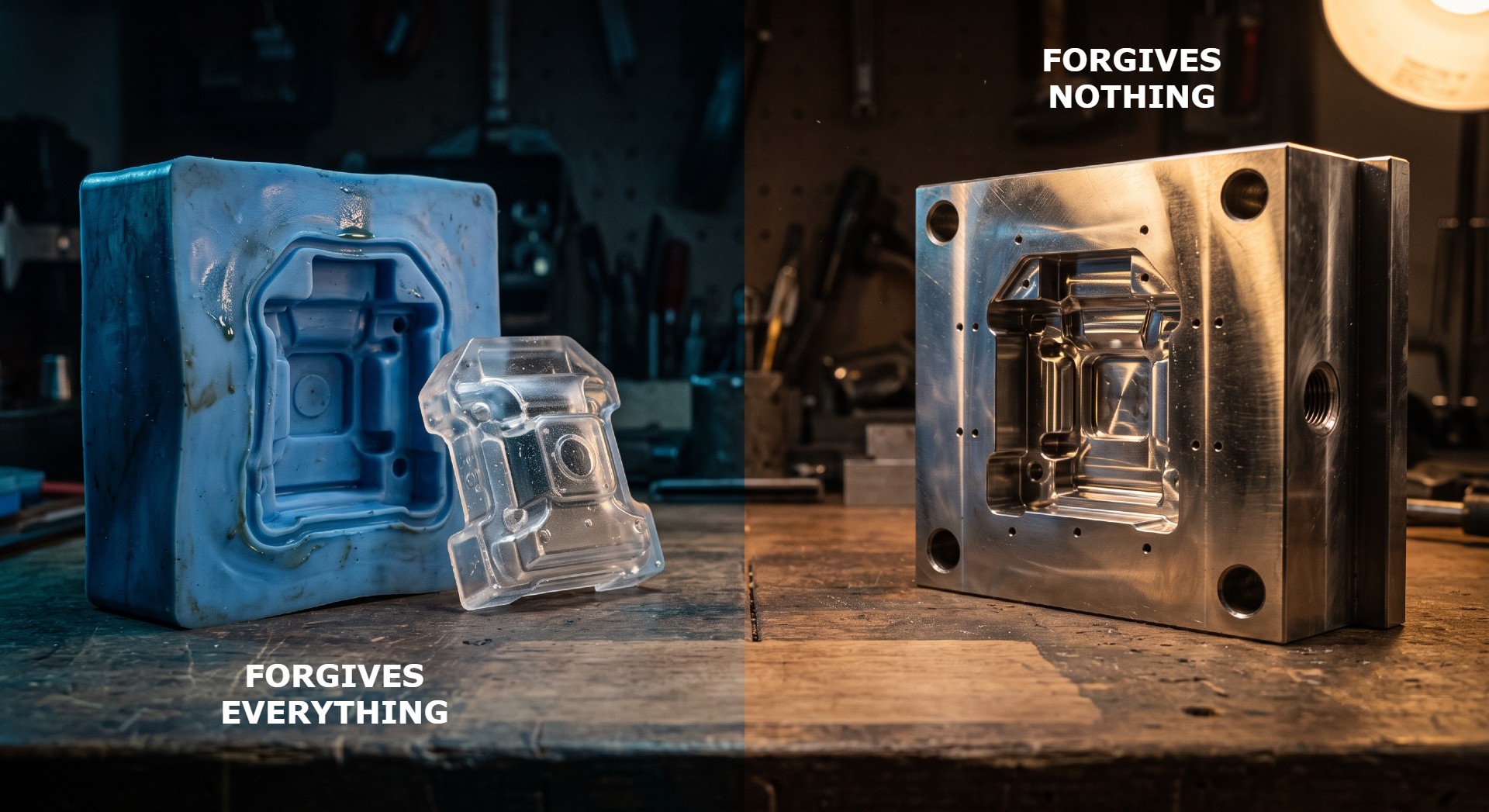
Vacuum casting is the fastest way to hold a production-quality part in your hand before committing to steel. Pour polyurethane resin into a silicone mold taken from a 3D printed master, pull a vacuum to draw out air, and a few hours later you have a part that looks and functions like the real thing. For a team validating form, fit, and function before a five-figure tooling commitment, it is one of the best tools available.
It is also a trap, and the trap is exactly the thing that makes it useful. Vacuum casting is forgiving. Injection molding is not. And if you treat the forgiving process as a preview of the unforgiving one, you can design yourself into a corner you only discover after the design is frozen.
What vacuum casting actually validates, and what it does not
Vacuum casting validates geometry. Does the part fit its mating components, does the assembly go together, does the button click, does the enclosure close. For all of that it is excellent, and a cast part answers those questions far more cheaply and quickly than a cut tool.
What it does not validate is the material truth. The polyurethane resins used in casting are analogues of production thermoplastics, not the real thing. A resin can approximate the stiffness of ABS or the flex of TPU, but its shrinkage, its exact modulus, its temperature resistance, and its long-term behavior all differ from the injection-grade material you will actually ship.
⚠️ Proof of geometry vs proof of material
Treat a cast prototype as proof of form, fit, and function—never as proof of material performance. A cast part that passes a drop test tells you the geometry survived. It does not tell you the injection-molded version in the real resin will behave the same way, because the material underneath is fundamentally different.
The permissive process and the strict one
Here is the core of the problem. Vacuum casting will happily produce geometry that injection molding rejects outright.
A flexible silicone mold stretches and peels away from the part during demolding. That means it tolerates zero draft, deep undercuts, and complex geometry that a rigid steel tool could never release without sliders or lifters. It also tolerates wildly uneven wall thickness, because the resin cures slowly at low pressure rather than being packed in under thousands of PSI.
Injection molding forgives none of that. A rigid steel cavity needs draft to eject the part. Undercuts require slider and lifter mechanics, each adding tooling cost. Uneven walls cause sink, warp, and inconsistent fill. The list of things casting shrugs off and injection punishes is long, and every item on it is a place where a validated cast design can turn out to be unmoldable.
The failure sequence looks like this: A team casts a part with no draft and a couple of convenient undercuts. It works perfectly. Everyone signs off. The design freezes. Then it goes to injection tooling, and the supplier's first DFM report comes back asking for draft on every face and a redesign of the undercut features. Now the "frozen" design is being reopened after validation—which is the single most expensive moment in the entire development timeline to change anything.
💡 The fix is a habit, not a step
Design for injection molding from your very first cast prototype. Add the draft, respect the wall thickness rules, and resolve the undercuts, even though the casting process would let you skip all of it. You lose nothing in the cast part, and you arrive at injection tooling with a design that clears DFM in one round instead of three.
Why the dimensions do not transfer either
Even when the geometry is moldable, the numbers do not carry over cleanly, and it helps to understand why.
A cast part's accuracy is inherited through a multi-stage chain: The SLA printed master has its own tolerance. The silicone mold taken from that master adds another layer of error. And the silicone degrades with every pull, so dimensions drift as the mold ages.
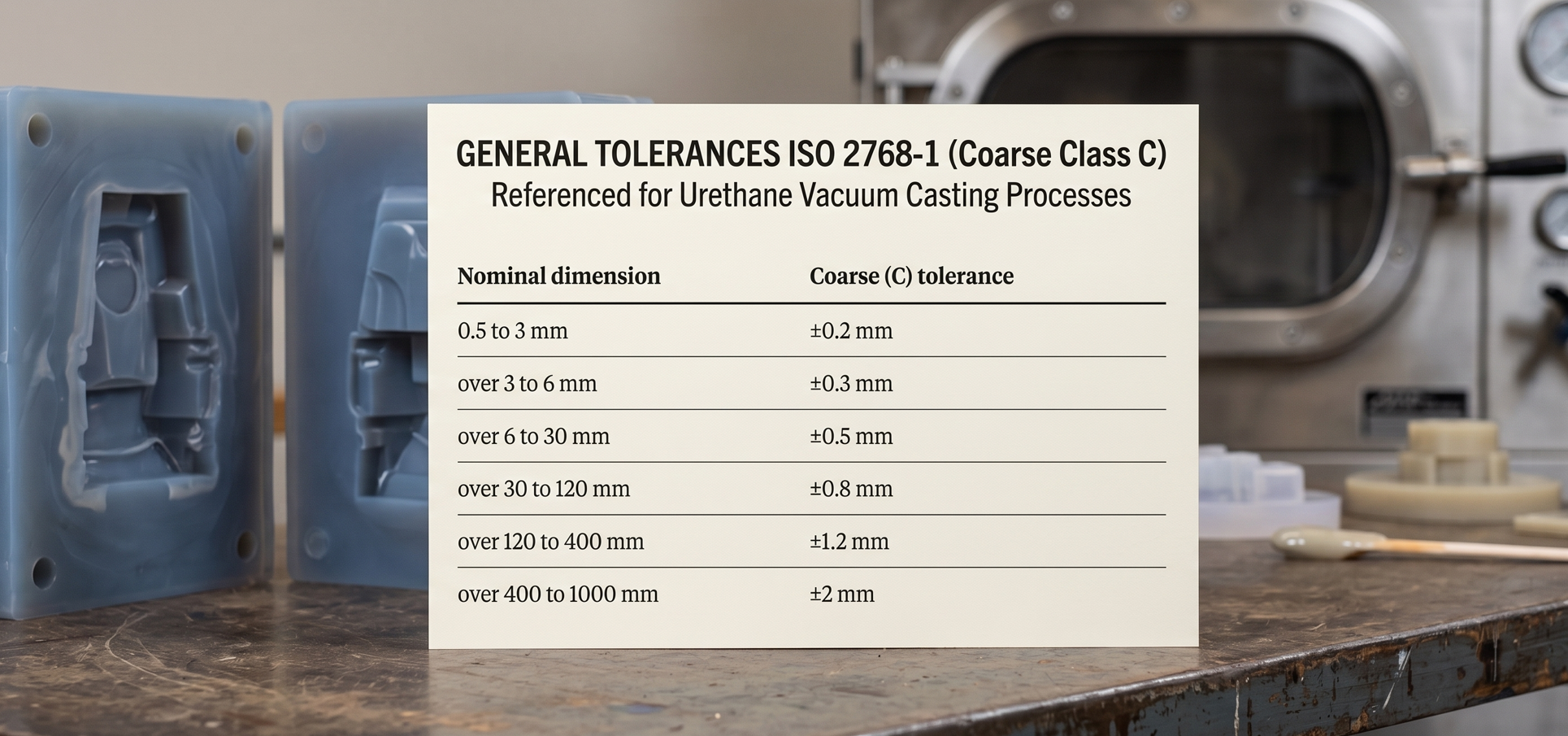
A realistic target for well-designed cast parts follows ISO 2768-1 Coarse Class C:
- 0.5 to 3 mm: ±0.2 mm
- over 3 to 6 mm: ±0.3 mm
- over 6 to 30 mm: ±0.5 mm
- over 30 to 120 mm: ±0.8 mm
- over 120 to 400 mm: ±1.2 mm
- over 400 to 1000 mm: ±2.0 mm
Injection molding, once dialed in, holds much tighter and more repeatable tolerances than this because a rigid steel cavity does not stretch, drift, or degrade over a short life. So a part validated at cast tolerances may behave differently once molded to injection tolerances, particularly on tight mating features.
The batch number that decides when to switch
A silicone mold is not a durable tool. Depending on part complexity, resin, and cosmetic requirements, a single silicone mold yields roughly 10 to 12 good parts before dimensional drift and wear make it unreliable. Demanding parts, clear resins, or abrasive filled materials pull that number toward the low end; simple opaque parts reach the higher end.
That physical limit, not just economics, is what sizes vacuum casting correctly. It is the right process for tens of parts: a validation batch, a pilot run, a first customer trial of 20 to 50 units cast across a few molds. It is the wrong process for hundreds. When your real order volume climbs past what a handful of molds can produce, the per-part economics and tolerance consistency both point to injection tooling.
💡 Use the batch limit as your planning anchor
If you need 30 parts to validate and run a pilot, vacuum casting is correct. If you are already confident you will need several hundred, the time spent casting is better spent finishing injection DFM and cutting the tool.
The one habit that separates a smooth transition from a redesign
Everything in this chapter reduces to a single discipline: validate in vacuum casting, but design for injection molding from the start.
Let the casting process prove your geometry, your fit, and your assembly. Let it give you real parts in days instead of weeks. But do not let its permissiveness lull you into freezing a design that injection molding cannot make. Add the draft. Respect the wall sections. Resolve the undercuts. Lock the material with injection shrinkage in mind, not cast resin behavior.
Do that, and vacuum casting becomes exactly what it should be: a fast, cheap preview of a part you already know the production tool can make.