
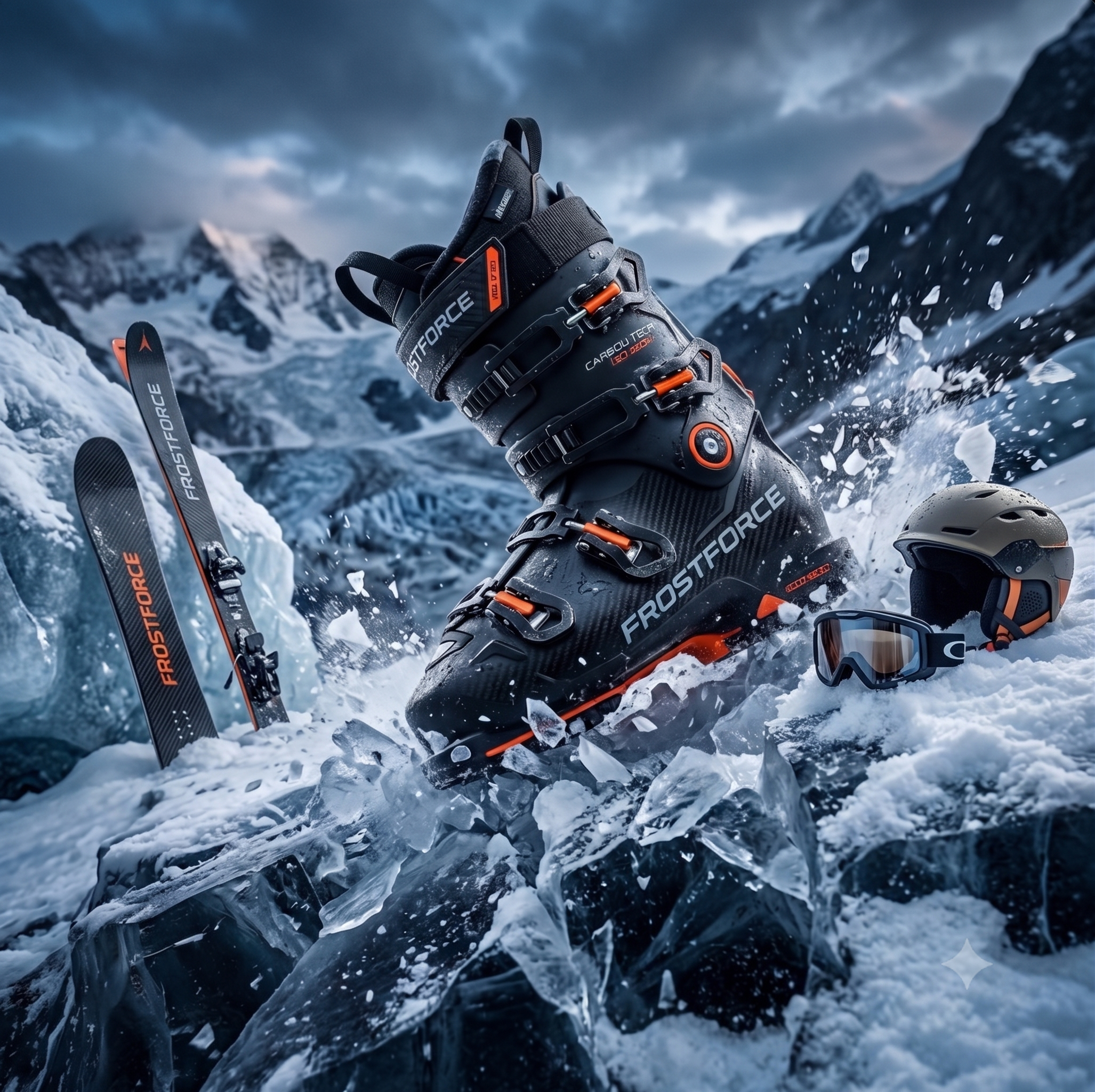
A design is only as robust as the polymer it is molded from. Specifying material based on a room-temperature datasheet will get someone hurt. In winter sports, it can get someone killed.
Two separate thermal threats exist for any winter sports product, and conflating them is a common design mistake.
The first is the storage and transport window: from roughly -30°C in an unheated van to +60°C in a car boot parked in August sun. This range governs creep resistance, warping, and dimensional stability. A boot shell that deforms in a hot car will never fit the same way again.
The second is the operating window: the temperatures the product actually sees in use, typically -20°C to +5°C for alpine skiing. This range governs flex modulus, impact resistance, and fatigue performance. These are the conditions that determine whether the product performs as designed.
Designing only for the operating window and ignoring storage is how you get field returns from customers in July. Designing only for storage and ignoring operating behavior is how you get a product that skis like a plank of wood on a cold morning.
Why your ski boot feels different on cold days
Standard thermoplastic polyurethanes stiffen by approximately 400% across the +20°C to -20°C operating window for alpine skiing. In practical terms, a 90-flex boot at -15°C can feel like a 110-flex boot. The boot you try in a warm shop and the boot you ski on are physically different products. That gap is a material engineering failure, not a sizing issue.
The three materials fighting that battle
TPU: the workhorse
TPU dominates mid-range boots because boot fitters can heat, grind, and stretch it to fit the skier's anatomy. It has a more progressive flex pattern, is durable, and can easily be ground or punched for fitting. The downsides are higher weight and stiffness that is more sensitive to temperature.
Use it where thermoforming matters more than cold performance. Think twice below -15°C.
Pebax: the expensive solution that actually works
Pebax changes rigidity by only about 200% across the +20°C to -20°C range, compared to 400% for TPU. Halving the stiffness swing means the boot you test is close to the boot you ski. For a safety-critical product, that predictability is not optional.
It maintains its properties solidly across temperature differences, offers prolonged flexibility at low temperatures, high resistance to cold impact, and excellent energy return, at around 20% less weight than the most popular alternatives.
One honest caveat: its energy return, a clear advantage in touring boots, becomes a liability at racing speeds where vibration absorption beats energy transmission every time. Material selection is always context-specific.
Grilamid TR90: the touring industry's quiet favourite
EMS-Grivory's transparent PA12, used by Scarpa and La Sportiva in lightweight touring shells. It offers very high flexural fatigue strength, toughness at low temperatures, dimensional stability, and low water absorption compared to other polyamides. It does not have quite as progressive a flex pattern as TPU, but the weight savings and strength for backcountry-specific boots make the trade worthwhile.
💡 If you are designing anything for cold outdoor use where weight matters, EMS-Grivory's application guides are better starting documents than a generic datasheet.
Snowboard bindings: five polymers, one product, each doing a different job
A binding is arguably a more interesting injection molding case study than a ski boot, because every component uses a different polymer for a specific mechanical reason.
- Baseplate: glass-filled nylon (PA6-GF30 or GF45) for stiffness and fatigue resistance under lateral load. Entry-level bindings use polycarbonate instead — cheaper and lighter, but it creeps under sustained edge force, which is why you do not find it on carving-focused bindings.
- Highback: unreinforced or lightly glass-filled nylon. It flexes thousands of times per season. Peak stiffness is not the requirement here, fatigue endurance is. The section geometry does most of the flex tuning; the material sets the operating range.
- Straps: TPU, almost universally. It stays flexible at -25°C, survives UV and abrasion, and ratchets reliably through a gloved hand. Nothing else affordable does all three.
- The overmolding trick: Switchback's AERON base overmolds forged aluminum with the highest grade polyamide nylon, stronger and lighter than either material alone, with a smaller footprint and toolless adjustability. The aluminum provides structural precision. The nylon overmold provides the interface, damps vibration, and eliminates hardware. Neither material alone gets there.
💡 If you are designing a product that joins metal structure to a polymer interface, study how binding manufacturers execute heelcup overmolding. It is a better practical education in joint design than most engineering textbooks.
The one rule that overrides everything else
Never specify a material for a cold-environment product using room-temperature datasheet values. Request mechanical data at -20°C and -30°C from your compounder. If they cannot provide it, find a different supplier.
The number that matters is not tensile strength at 23°C. It is the ratio of flex modulus at -20°C to flex modulus at +20°C. That ratio tells you whether your product will perform consistently across the conditions it will actually see, or whether your customers will discover the problem for you on a cold January morning.
| Requirement | First choice | Why | Avoid |
|---|---|---|---|
| Shell, flexible, weight-critical | Pebax / PEBA | 200% modulus swing vs 400% for TPU, 20% lighter | Standard TPU |
| Shell, touring, stiff, scratch-resistant | Grilamid TR90 | Low water absorption, cold impact, UV stable | PA6, PA66 |
| Shell, thermoformable, mid-range | TPU polyether | Boot fitting compatible, progressive flex | TPU polyester (stiffer cold) |
| Structural baseplate, stiff | PA6-GF30/45 | Fatigue, dimensional stability under load | Polycarbonate (creep) |
| Highback, fatigue-critical | PA6-GF20 or fiberglass composite | Flex cycle endurance | Unreinforced PA |
| Straps, cold flexibility | TPU | Stays flexible below -20°C | PP, ABS (brittle impact) |
| Precision housing, wet environment | PA12 / Grilamid | Low water uptake vs PA6/66 | PA6 (high moisture sensitivity) |
| Topsheet / decorative layer | Rilsan PA11 | UV stable, sublimation print compatible | Standard PA6 topsheet |