

Draft is an absolute thermodynamic and mechanical necessity in injection molding. It is a slight taper applied to all vertical walls parallel to the line of draw (the direction the mold opens). As molten polymer cools, it undergoes volumetric shrinkage and grips the internal core of the mold with immense compressive force. When the mold opens, a part designed with zero draft will act like a brake pad against the cavity walls, causing severe friction, deep drag marks, and potential destruction of the tool.
💡 The Texture Oversight
"Most junior or inexperienced engineers tend to not define or think about the texture of the parts until the whole design is finished, causing a full redesign of the part and adjacent components due to unfitted surfaces caused by the drafts needed to apply a rougher VDI texture. Rougher surface = higher draft."
For standard, smooth-finish parts, a draft of 1° to 2° is widely recommended, with inner drafts maintained at 0.5° as an absolute minimum. For exceptionally deep draws, the industry rule of thumb is to add an additional 1° of draft for every inch (25.4 mm) of depth.
The VDI 3400 Standard: EDM vs. Chemical Etching
The physics of ejection change dramatically when cosmetic surface textures are introduced. The global benchmark for mold texture is the VDI 3400 standard (established by the Society of German Engineers), which categorizes roughness across 45 specific grades, ranging from near-mirror finishes to heavy, abrasive textures.
Historically, VDI 3400 finishes were imparted using Electrical Discharge Machining (EDM). The mold cavity acts as an anode, and a precisely shaped copper or graphite electrode acts as a cathode. Submerged in dielectric fluid, electrical sparks jump between the two, literally burning microscopic, overlapping craters into the steel to create the texture.
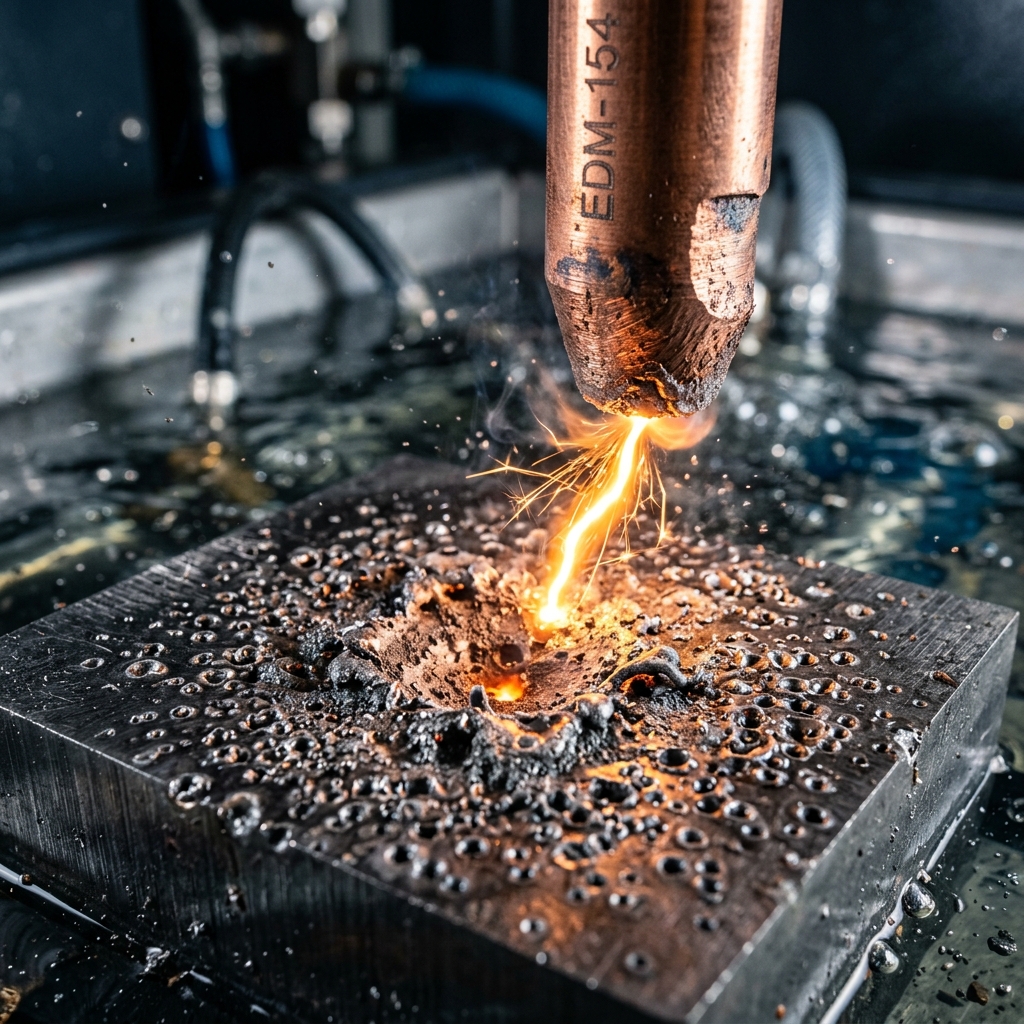
While EDM is highly controllable for small areas, achieving a perfectly uniform VDI 3400 texture across massive components such as automotive bumpers or television bezels is exceptionally difficult. For large-scale texturing, advanced toolmakers now rely on chemical etching. The mold is polished to a flawless finish (Ra ≤ 0.4 µm), specific areas are masked off with a protective film, and an acid bath is applied. The acid chemically erodes the exposed steel, yielding highly uniform, complex patterns ranging from fine sand to deep leather grains. While chemical etching provides superior uniformity over vast areas, it represents a more complex, multi-stage, and costly process than standard EDM.
Drafting for Texture
A texture consists of microscopic peaks and valleys machined into the steel (measured as Rz, or roughness depth). If a highly textured part is designed with minimal draft, the shrinking plastic will permanently interlock with the steel peaks. Upon ejection, the force of the ejector pins will physically shear the plastic across the steel face, destroying the texture, leaving white scratch marks (scuffing), and ruining the cosmetic surface.
The industry standard calculation requires adding roughly 1° to 1.5° of extra draft for every 0.025 mm of texture depth. The following table, synthesized from VDI 3400 technical guidelines, illustrates the exponential relationship between surface roughness and the minimum safe draft angles required for common thermoplastics like Polyamide (PA/Nylon), Polycarbonate (PC), and ABS.
| VDI 3400 Grade | Roughness Ra (µm) | Roughness Depth Rz (µm) | Minimum Draft PA | Minimum Draft PC | Minimum Draft ABS |
|---|---|---|---|---|---|
| VDI 12 | 0.40 | 1.5 | 0.25° | 1.0° | 0.5° |
| VDI 18 | 0.80 | 3.3 | 0.5° | 1.0° | 0.5° |
| VDI 24 | 1.60 | 6.5 | 0.5° | 1.5° | 1.0° |
| VDI 30 | 3.15 | 12.5 | 1.5° | 2.0° | 2.0° |
| VDI 36 | 6.30 | 24.0 | 2.5° | 4.0° | 3.0° |
| VDI 42 | 12.50 | 48.0 | 4.0° | 6.0° | 5.0° |
| VDI 45 | 18.00 | 69.0 | 5.0° | 7.0° | 6.0° |
⚠️ Material Warning: The rigidity of the polymer drastically influences draft. Highly stiff materials like Polycarbonate (PC) or glass-reinforced nylons resist flexing during ejection and therefore require more aggressive draft angles than standard ABS.